By the end of this page, you will know what the words on an orthodontic treatment plan mean, for you or for your child. Right now it may be the other way round: someone said overbite, overjet or attachments, and you nodded along. That is normal, and asking what a word means is never a silly question. There is no judgment here.
This guide puts the jargon into plain English, in the order you are likely to hear it, grouped by what each word describes: your bite, clear aligners and retainers. For every word, you get what it means and why it matters. The first word to translate is orthodontics itself.
What is orthodontics, in plain English
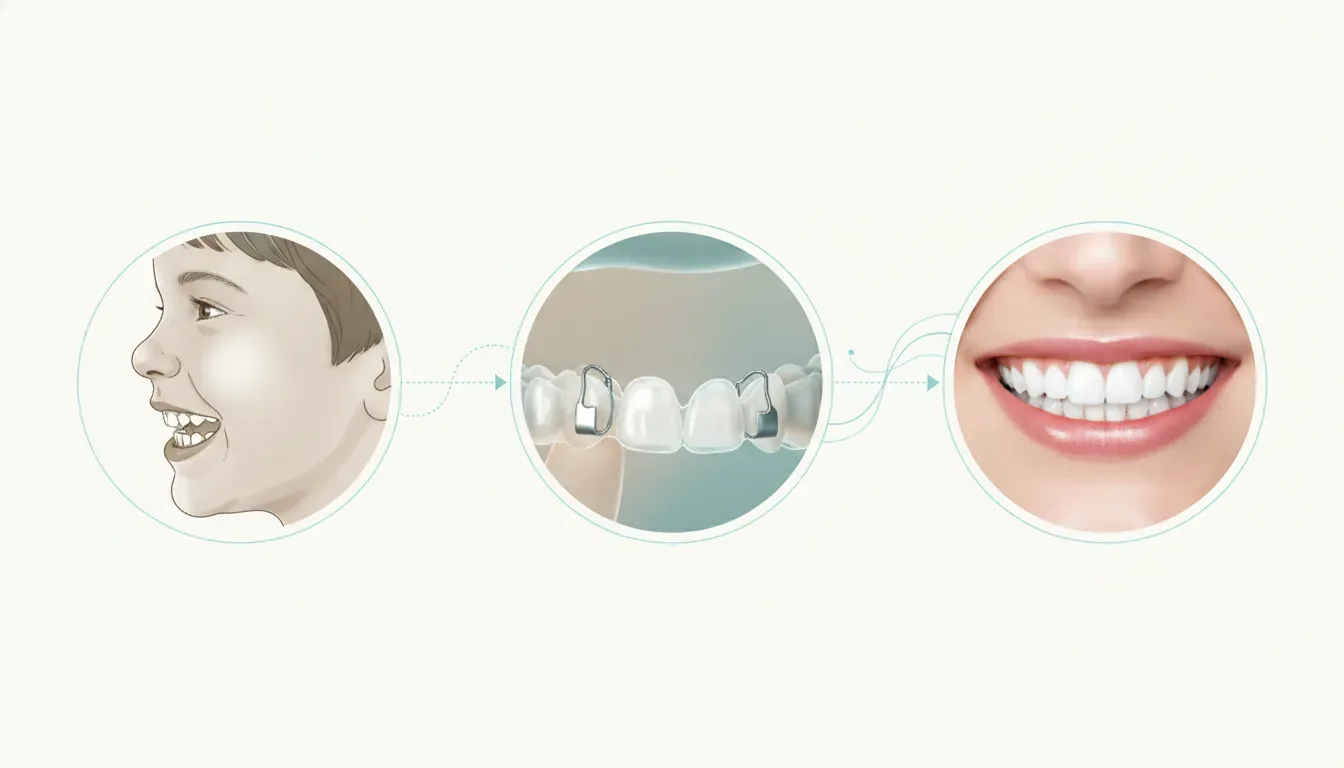
Orthodontics is the branch of dentistry that deals with how teeth line up and how the upper and lower teeth meet, which dentists call your bite. It uses clear aligners, braces and retainers to straighten teeth and correct a bad bite, which dentists call a malocclusion.
The short version
- An orthodontist is a dentist with two to three years of extra training after dental school.
- Teeth move because gentle, steady pressure lets the bone around them reshape.
- Everyone who finishes treatment needs a retainer.
- The American Association of Orthodontists suggests a child’s first orthodontic check by age 7.
On this page
What is the difference between an orthodontist and a dentist
An orthodontist is a dentist who completed two to three years of extra training after dental school, focused on straightening teeth and fixing bites. According to Cleveland Clinic, an orthodontist does not usually do fillings, crowns or bridges.
A general dentist handles checkups, cleanings and repairs, and is often the first person to notice a bite problem. Many general dentists also provide clear aligner treatment for suitable cases. That is the difference in one line: the orthodontist has extra training in bites, and the general dentist looks after the whole mouth.
Do you need a referral? Many orthodontists see patients without one, and your dentist can recommend an orthodontist if that is the better route for you.
Whoever you see, the conversation soon turns to the tools used to move teeth, which raises a common question.
Is orthodontics just braces
No. Orthodontics uses clear aligners, braces, retainers and, for some children, palate expanders. Each is a different tool for the same job.
- Clear aligners are a series of custom, removable clear plastic trays. You wear each set for one to two weeks before moving to the next. Invisalign is the best-known brand.
- Braces are fixed to the teeth. Brackets are glued to each tooth and joined by a wire, sometimes with bands, and they gradually shift the teeth.
- Retainers are worn after treatment to hold teeth in their new place.
- A palate expander is used in some children to widen the upper jaw. Most children do not need one.
So orthodontics is not just braces. At Dentique, straightening is done with Invisalign clear aligners, and we make custom retainers; we do not place braces.
All four tools exist to correct the same thing: the bite.
What do the bite words actually mean
Your bite is the way your upper teeth and lower teeth meet when you close your mouth. When a bite does not meet the way it should, orthodontists call it a malocclusion. Here are the words you are most likely to hear, one at a time.
What is a malocclusion?
Malocclusion is the umbrella word for any bad bite, or for teeth that are out of line. Every word below describes one kind of malocclusion.
What is an overbite, and what is a deep bite?
An overbite is when the upper front teeth overlap down over the lower front teeth. Some overlap is normal. A deep bite, sometimes called a deep overbite, is when the upper teeth cover too much of the lower teeth.
What is an overjet?
An overjet is when the upper front teeth stick out forward, ahead of the lower teeth; people often call this buck teeth. The difference from an overbite is direction. An overbite is up-and-down overlap. An overjet is front-to-back distance.
What is an underbite?
An underbite is when the lower teeth sit in front of the upper teeth when you close. Cleveland Clinic describes it as the lower teeth sticking out further than the upper teeth.
What is a crossbite?
A crossbite is when some upper teeth sit inside the lower teeth instead of outside them. It can happen at the front of the mouth or at the sides.
What is an open bite?
An open bite is when the front teeth do not touch, even with the back teeth together.
What do crowding and spacing mean?
Crowding means there is not enough room, so teeth overlap or twist. Spacing is the opposite: gaps between teeth.
Why do these words matter? Cleveland Clinic notes that teeth in proper alignment are much easier to clean, which lowers the risk of cavities and gum disease. A bite that does not meet well can also affect chewing and how teeth wear over time. None of these words is an emergency on its own. Each one describes a position, and that raises the obvious question: how can a tooth in any of these positions move at all?
How do teeth actually move
Teeth move because gentle, steady pressure lets the bone around them slowly reshape. Teeth are not fixed solid into the jaw. Each tooth sits in a socket, held by a thin layer of fibres called the periodontal ligament, which works a bit like a hammock.
When an aligner or braces press steadily on a tooth, bone on the pressure side slowly clears away, and new bone fills in on the other side. The tooth moves through the bone, a little at a time.
That is why treatment happens gradually, with aligner trays changed every one to two weeks. It is why each new aligner can feel snug for a day or two while the pressure does its work. It is also why teeth need a retainer while the bone settles around their new position.
If your treatment uses clear aligners, a new set of words comes with them.
What do the clear aligner words mean
Clear aligners are a series of thin, custom-made clear plastic trays; Invisalign, made by Align Technology, is the best-known brand. You wear each tray for one to two weeks, and each one moves your teeth a little further. These are the words that come with them.
Digital scan or impressions
A digital scan or impressions is how the dentist records the shape of your teeth so the trays can be planned. Either way, it captures where your teeth sit today.
Treatment plan
A treatment plan is the step-by-step map of where each tooth will move, tray by tray.
Wear time
Wear time is how many hours a day the trays are in. The American Association of Orthodontists says aligners should be worn a minimum of 22 hours a day, in the correct order. You take them out to eat, to drink anything other than water, and to clean your teeth.
Attachments
Attachments are small, tooth-colored bumps bonded to some teeth so the trays have something to grip. Not everyone needs them, and only your dentist removes them at the end, usually in a short visit.
IPR (interproximal reduction)
IPR, short for interproximal reduction, is when the dentist smooths a very small amount of enamel between some teeth to make room for them to move.
Refinement
Refinement is an extra set of trays near the end of treatment to fine-tune a few teeth that need a little more movement.
When the last tray is done, one more word matters more than the rest: retainer.
What is a retainer, and why does everyone need one
A retainer is a custom appliance worn after braces or aligners come off, and it helps keep teeth from drifting back while the bone around them settles. The American Association of Orthodontists says all patients will need to wear retainers after treatment. Cleveland Clinic adds that if you stop wearing your retainer, your teeth could drift back into their old positions over time.
That links straight back to how teeth move. The bone around a newly moved tooth is still settling, so the retainer holds the tooth while that happens. A retainer is part of treatment, not an extra.
Retainers come in a few types:
- A clear retainer is a removable clear tray, similar to an aligner.
- A fixed retainer is a thin wire bonded behind the front teeth.
- A Hawley retainer is removable and made of wire and acrylic.
Your dentist recommends the type that suits you and how often to wear it, so wear it as directed. Dentique Dental Care makes custom retainers.
The other big question is timing: when is the right moment to get teeth checked in the first place?
When should you, or your child, get teeth checked for orthodontics
The American Association of Orthodontists recommends a child’s first orthodontic check no later than age 7. Most children will not need treatment at that age; the first check is a chance to spot anything worth watching as teeth and jaws grow.
What age is too late for an adult? There is no cut-off. MedlinePlus notes that most people who receive orthodontic care are kids, but adults get treatment too.
At any age, one rule comes first: healthy teeth and gums first. Cleveland Clinic advises that people with serious decay or gum disease have those treated before orthodontic treatment starts, because moving teeth that are not healthy can cause harm.
A regular checkup is a natural place to ask. Dentique provides children’s and family dentistry, and a checkup is a chance to look at how teeth and bite are developing. If an orthodontic check makes sense for your child or for you, the dentist will say so.
Once treatment starts, the next question is usually what day-to-day life feels like.
What is normal during treatment, and what is not
Orthodontic treatment takes time: for some people less than a year, for others up to two years or longer, depending on the case. Along the way, a few things are expected and a few are worth a call.
Usually normal
- Pressure, or feeling sore for a day or two after switching to a new tray.
- A slight lisp in the first days with aligners.
- Needing to clean your teeth more carefully. Cleveland Clinic notes a greater risk of cavities if you do not clean well around orthodontic appliances.
Call your dentist if
- Something breaks or cracks.
- A tray stops fitting.
- An attachment comes off.
- Pain does not settle.
If the dental chair itself is the worry, say so. Dentique offers laughing gas (nitrous oxide) and oral conscious sedation, a pill to relax you, for visits that need it.
That leads to a plain question: what does Dentique itself do, and what does it not do?
What does Dentique do for orthodontics, and what does it not do
Dentique Dental Care straightens teeth with Invisalign clear aligners and makes custom retainers, at its offices in Downers Grove and Lemont. It does not place braces, and if an orthodontist or fixed braces would suit your case better, Dr. Shuaipaj will tell you so.
What we do: one dentist, Dr. Xhelo Shuaipaj, with more than 30 years in practice, looks at your teeth and bite and explains your options in plain words. What we do not do: braces, or pressure. Any price is confirmed in writing at the consultation, before anything starts.
No judgment, either. Plenty of patients come in after years away from the dentist, and nobody is lectured. Some patients have stayed with the practice for 15, 20 and 25 years.
Dentique works with most major PPO plans, including Delta Dental, MetLife, Cigna, Aetna, Blue Cross Blue Shield of Illinois, UnitedHealthcare, Guardian and Humana. Financing is available through CareCredit, Cherry and Sunbit.
Offices: 4121 Fairview Ave, Suite 205, Downers Grove, IL 60515, and 15543 W 127th St, Suite 103, Lemont, IL 60439.
A few questions come up often enough to answer directly.
Frequently asked questions
Is Invisalign orthodontics?
Yes, Invisalign is orthodontics. Invisalign is a brand of clear aligner, and clear aligners are an orthodontic treatment used to straighten teeth and correct a bad bite. At Dentique, Invisalign is provided by a general dentist, Dr. Xhelo Shuaipaj, who plans your treatment and checks it through to the retainer.
Can a general dentist do Invisalign?
Yes. A general dentist can provide Invisalign, and many do for suitable cases; Dentique is one of them. Some complex bites are better treated by an orthodontist, and a good dentist will say so plainly. At Dentique, if an orthodontist would suit your case better, Dr. Shuaipaj will tell you.
Is $6000 too much for braces?
Whether $6000 is too much for braces depends on the case, how long treatment runs and the method used, so one number cannot answer it fairly. Dentique does not offer braces. For clear aligners, your price is confirmed in writing at the consultation, with PPO insurance and financing through CareCredit, Cherry and Sunbit discussed up front.
Does insurance cover braces for kids?
Insurance for braces for kids depends on the plan. Some dental plans include an orthodontic benefit, often for children, and many set limits. The simplest step is to check your plan, or ask the office to check it for you. Dentique works with most major PPO plans, including Delta Dental, MetLife, Cigna, Aetna, Blue Cross Blue Shield of Illinois, UnitedHealthcare, Guardian and Humana.
What are some common orthodontic phrases?
Common orthodontic phrases include malocclusion (a bad bite) and the bite words overbite, overjet, underbite, crossbite and open bite, plus attachments and refinement for clear aligners, and retainer for what comes after. Each one is explained in plain English earlier on this page.