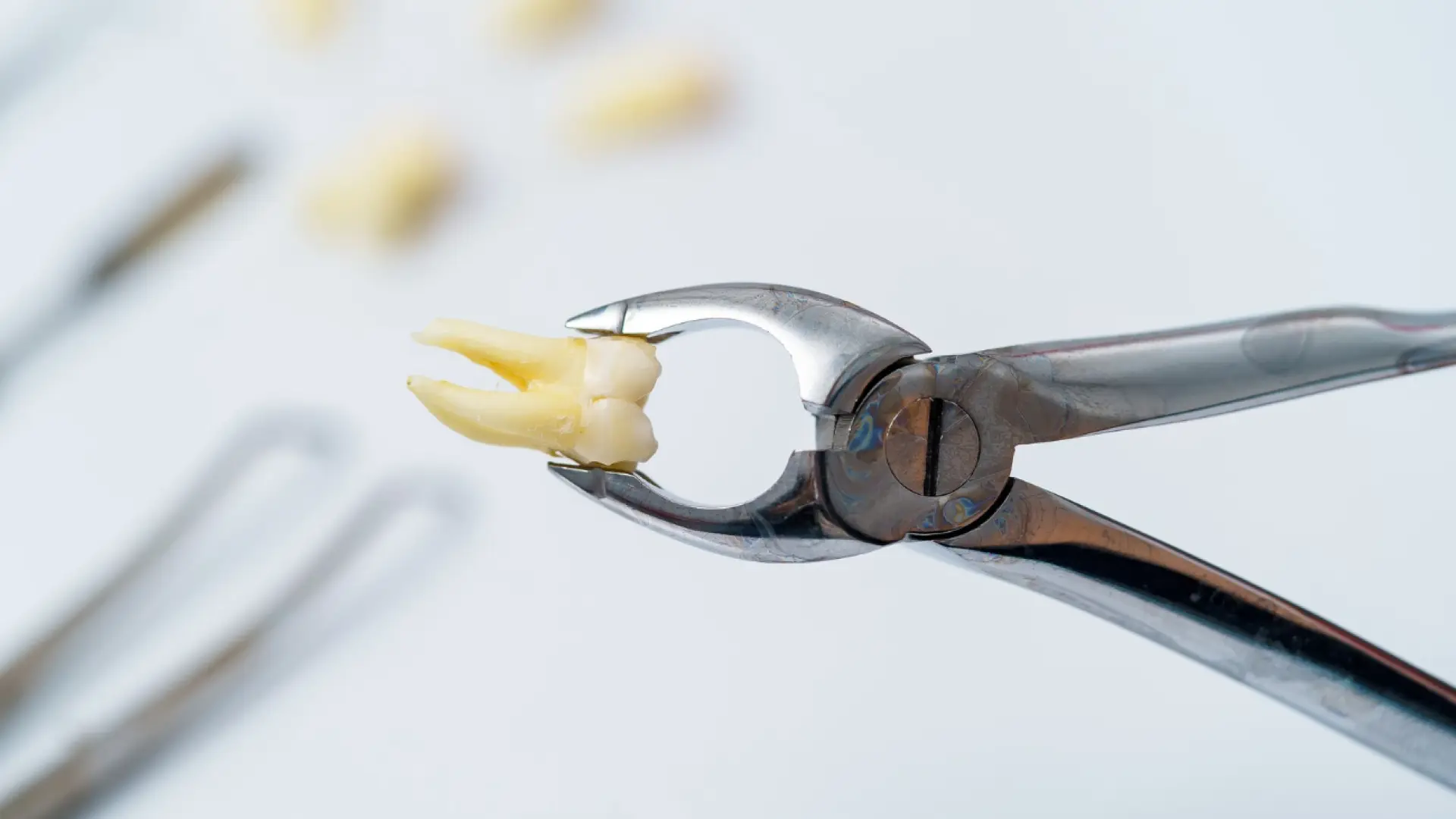
| Dry socket, the most common complication after a tooth extraction, affects 2% to 5% of all extractions and up to 20% of impacted wisdom tooth removals. It typically develops 2 to 4 days after the procedure and resolves within 7 to 10 days with prompt dental care. |
That statistic surprises most patients, because pain after an extraction is so common that the line between normal healing and a real problem feels invisible. This guide draws that line. The 2% to 5% figure comes from Cleveland Clinic dry socket data and the day-by-day rules below come from how a tooth extraction at Dentique is actually managed. You will get the full day-by-day healing timeline, the exact rules that prevent dry socket, what to avoid in the first 24 hours, the first week, and the first two weeks, and when a call to the office is worth making.
Tooth Extraction Aftercare: The Day-by-Day Healing Timeline
| After a tooth extraction, a blood clot forms in the socket within the first 24 hours and acts as the foundation for healing. Soft tissue closes over the site by roughly Day 4 to 7. Bone remodelling underneath continues for several weeks to months. The first 7 to 10 days carry the highest risk for complications. |
Most patients searching for aftercare are scared about the recovery part more than the procedure. The healing follows a predictable order, and knowing what each stage looks like is what turns that fear into a checklist you can manage. Here is what happens, day by day.
The First 24 Hours (Day 0)
A blood clot forms in the empty socket. Your only job is to protect it, because that clot is what the entire healing process is built on. Bite gently on the gauze your dentist placed for 30 to 45 minutes to help the clot set, following the standard guidance dentists give for stopping the initial bleeding.
What is normal: minor oozing that tints your saliva pink for a few hours, mild discomfort as the local anaesthetic wears off, and some early swelling. What is not normal: gauze that soaks through in under 30 minutes, or bleeding that will not slow with steady pressure. What to do: rest, keep your head elevated, avoid straws, smoking, vigorous rinsing, and probing the area with your tongue.
Days 1 to 3
Swelling peaks somewhere around 48 to 72 hours, then begins to fade. Pain is usually at its strongest on Day 1 and eases a little each day after. You can start gentle saltwater rinses after the first 24 hours, swishing softly rather than forcefully so the clot stays put.
This is the window where patients most often panic about whether bleeding or pain is an emergency. If something feels genuinely alarming, the dental emergency steps walk through what to do before you reach the office. For most people, Days 1 to 3 are uncomfortable but steadily improving.
Days 4 to 7
Soft tissue begins closing over the socket. Pain should now be clearly fading rather than building. If pain instead worsens around Day 2 to 4, that is the classic signal of dry socket, covered in the next section. By the end of this week most patients are back to a near-normal routine, though the socket is still healing underneath.
Days 7 to 14
The gum tissue continues to close and firm up. You can gradually reintroduce more normal foods, chewing away from the extraction site, and most day-to-day discomfort is gone. The dry socket risk window is closing as you move through this stretch.
Beyond Two Weeks: Bone Remodelling
The visible part of healing is done, but bone remodelling inside the socket continues quietly for several weeks to months. This is normal and requires nothing from you beyond your usual oral hygiene. If you are planning a future implant in that spot, this remodelling phase is part of why your dentist may wait before placing one.
What Is Dry Socket and How Do You Prevent It?
| Dry socket, clinically called alveolar osteitis, happens when the protective blood clot over an extraction site dislodges or fails to form, exposing the underlying bone and nerves. It affects 2% to 5% of all extractions and up to 20% of impacted lower wisdom tooth removals. Onset is typically Day 2 to 4, and smokers face a substantially higher rate than non-smokers. |
Dry socket is the complication patients fear most, and the fear is reasonable because the pain is sharp and can radiate toward the ear, eye, or temple on the same side. The good news is that it is largely preventable, and prevention comes down to protecting that clot. A common piece of advice patients repeat is to keep gauze in place and stay hydrated so you do not mess up the blood clot, and that instinct is exactly right.
Why It Happens
The clot can be physically pulled out, dissolved, or disturbed before the tissue underneath has had time to heal. Anything that creates suction, introduces chemicals, or applies force to the area raises the risk.
The Prevention Rules and the Reason Behind Each
- No smoking for at least 72 hours: the suction pulls at the clot and the chemicals slow healing. Smokers see a dry socket rate of roughly 13.2% compared with about 3.8% in non-smokers.
- No straws: the suction created by drinking through a straw can lift the clot straight out of the socket.
- No vigorous rinsing or spitting for the first 24 hours: forceful swishing dislodges the clot before it has stabilised. Gentle saltwater rinses are fine after the first day.
- Be aware of higher-risk factors: hormonal contraceptives and more complex or surgical extractions both raise the odds, so patients in those categories should be extra careful.
How you know it is dry socket and not normal healing: pain that worsens after Day 2 rather than improving, a foul taste or bad breath, visible bone in the socket, and pain that radiates outward toward your ear or eye. Normal healing trends in the opposite direction, getting a little better each day.
What to Avoid: The Rules for the First 24 Hours, First Week, and First Two Weeks
| The single most important rule changes as you heal. In the first 24 hours, avoid anything that disturbs the clot: straws, smoking, and vigorous rinsing. In the first week, avoid hard, crunchy, hot, and spicy foods and chew on the opposite side. In the first two weeks, reintroduce normal foods gradually while the socket finishes closing. |
First 24 Hours
- No straws, no smoking, no vigorous rinsing, and no poking the socket with your tongue.
- No strenuous activity or heavy lifting, which can increase bleeding.
- Keep the gauze in place for 30 to 45 minutes after the procedure and replace it if needed.
First Week
- Avoid hard, crunchy, sticky, hot, or spicy foods. Stick to cool, soft foods such as yogurt, mashed potatoes, and smoothies eaten with a spoon rather than a straw.
- Chew on the opposite side of your mouth.
- Skip alcohol, which can interfere with healing and with any prescribed medication.
- Start gentle saltwater rinses after 24 hours, not before.
First Two Weeks
- Reintroduce normal foods gradually as comfort allows, still favouring the unaffected side.
- Keep the area clean and watch the socket as it closes.
- Finish any prescribed antibiotics or pain medication as directed, even if you feel fine.
Pain, Bleeding, and Swelling: What’s Normal and When to Call
| In the first 48 hours, expect pain that peaks on Day 1 and eases afterward, minor oozing for a few hours, and swelling that peaks around 48 to 72 hours. What is not normal: gauze soaked through in under 30 minutes, pain that worsens after Day 2, fever, visible bone, or numbness lasting more than 12 hours. Those warrant a call. |
A lot of patients tell us they keep overthinking what is normal and what is not, lying awake replaying every twinge. Clear criteria fix that. Normal pain peaks on Day 1 and can usually be managed with over-the-counter ibuprofen or acetaminophen and a cold compress applied in 10 to 20 minute intervals. Minor oozing for a few hours is expected. Swelling peaks at 48 to 72 hours, then recedes.
Some patients also wait to call because they worry about cost, especially after hours. If that is the hesitation, the emergency insurance coverage guide explains what a visit may actually involve, so a financial worry does not keep you from getting seen when you should.
| Call your dentist if any of these happen:Pain that worsens after Day 2 instead of improving (a common dry socket sign).Gauze soaking through in under 30 minutes, or bleeding that will not stop with steady pressure.Visible bone in the socket, or a foul taste and bad breath after Day 3.Fever, or numbness lasting more than 12 hours.Reach our Downers Grove office at (630) 454-9299 or our Lemont office at (630) 685-0017. |
Comfort at the Procedure: Sedation Options at Dentique
| Most simple tooth extractions need only local anaesthetic, so the area is numb and the procedure is painless. For anxious patients, longer procedures, or surgical extractions, Dentique offers two comfort options: nitrous oxide, which is light and wears off quickly, and oral conscious sedation, a pill taken before the visit. |
If you are scared about the recovery part more than the procedure, you are not alone, and the procedure itself is usually the easier half. Most simple extractions are done comfortably with local anaesthetic alone. For patients who feel real anxiety, or for more involved surgical extractions, comfort options exist so the experience is calm rather than something to dread.
Dr. Xhelo Shuaipaj, DDS, FDOCS, FICOI, has more than 25 years of experience and is a general and sedation dentist certified in implant placement and restoration. At Dentique, two sedation options are available: nitrous oxide, the light laughing gas that wears off within minutes of the mask coming off, and oral conscious sedation, a pill taken before your appointment to keep you relaxed throughout. You can read more about the oral conscious sedation and nitrous oxide options to decide what fits your comfort level.
Tooth Extraction Aftercare: Frequently Asked Questions
How long does a tooth extraction take to heal?
Soft tissue over the socket typically closes within about Day 4 to 7, and most people feel back to normal within a week to two weeks. The bone underneath, however, continues remodelling for several weeks to months, which is normal and requires nothing special from you. The first 7 to 10 days carry the highest risk for complications, so the early stretch is when careful aftercare matters most. If you are healing on schedule, your pain should ease a little each day after Day 1.
When can I stop worrying about dry socket?
The dry socket risk window is generally the first 7 to 10 days after your extraction, with onset most common between Day 2 and Day 4. Once you pass roughly the 7 to 10 day mark with steadily improving pain and no warning signs, the risk drops sharply. Throughout that window, protecting the clot is the priority: no smoking, no straws, and no vigorous rinsing in the first 24 hours.
What does dry socket feel like compared to normal pain?
Dry socket pain worsens after Day 2 or 3 instead of improving, which is the opposite of normal healing. It is often sharp and can radiate from the socket toward your ear, eye, or temple on the same side. You may also notice a foul taste, bad breath, or visible bone in the socket. Normal post-extraction pain, by contrast, peaks on Day 1 and eases a little each day, responding to over-the-counter pain relief.
How long do I have to wait before I can smoke after a tooth extraction?
Wait at least 72 hours, and longer is better. Smoking is one of the biggest dry socket risk factors: the suction pulls at the clot and the chemicals slow healing. The numbers make the case plainly, with smokers experiencing a dry socket rate of roughly 13.2% compared with about 3.8% in non-smokers. If you can use the recovery as a reason to pause longer, your socket will thank you.
What can I eat the first 24 hours after a tooth extraction?
Stick to cool, soft foods such as yogurt, mashed potatoes, applesauce, and smoothies eaten with a spoon rather than a straw. Avoid anything hot, spicy, hard, crunchy, or sticky, all of which can irritate or disturb the socket. Skip straws entirely, because the suction can dislodge the clot. Many patients want to know exactly when they can eat normally again, and the answer is to reintroduce regular foods gradually over the following one to two weeks.
How do I know when to call the dentist after an extraction?
Call if your pain worsens after Day 2 rather than improving, if gauze soaks through in under 30 minutes, if you see visible bone in the socket, or if you develop a fever or numbness lasting more than 12 hours. A foul taste or bad breath after Day 3 is also worth a call. If you are unsure whether to call the office or just wait it out, calling is the safer choice. Reach Downers Grove at (630) 454-9299 or Lemont at (630) 685-0017.
Does Dentique offer sedation for tooth extractions?
Yes. Most simple extractions need only local anaesthetic, but for anxious patients or more involved surgical extractions, Dentique offers nitrous oxide and oral conscious sedation. Nitrous oxide is light and wears off quickly once the mask is removed, while oral conscious sedation is a pill taken before your visit to keep you relaxed. Dr. Shuaipaj is a sedation-certified dentist, so your comfort options can be matched to the procedure and your anxiety level.
Talk to the Dentique Team
If you have an upcoming extraction, or you are recovering from one and something is not adding up, the easiest first step is a call. Call our Downers Grove office at (630) 454-9299 or our Lemont office at (630) 685-0017 to talk through your questions. If you would rather start with a written message, our team is reachable through the contact form. We will listen, ask the right questions, and decide together whether you need to come in or whether what you are experiencing is normal. You can also learn more about oral surgery at Dentique if you are still in the planning stage.