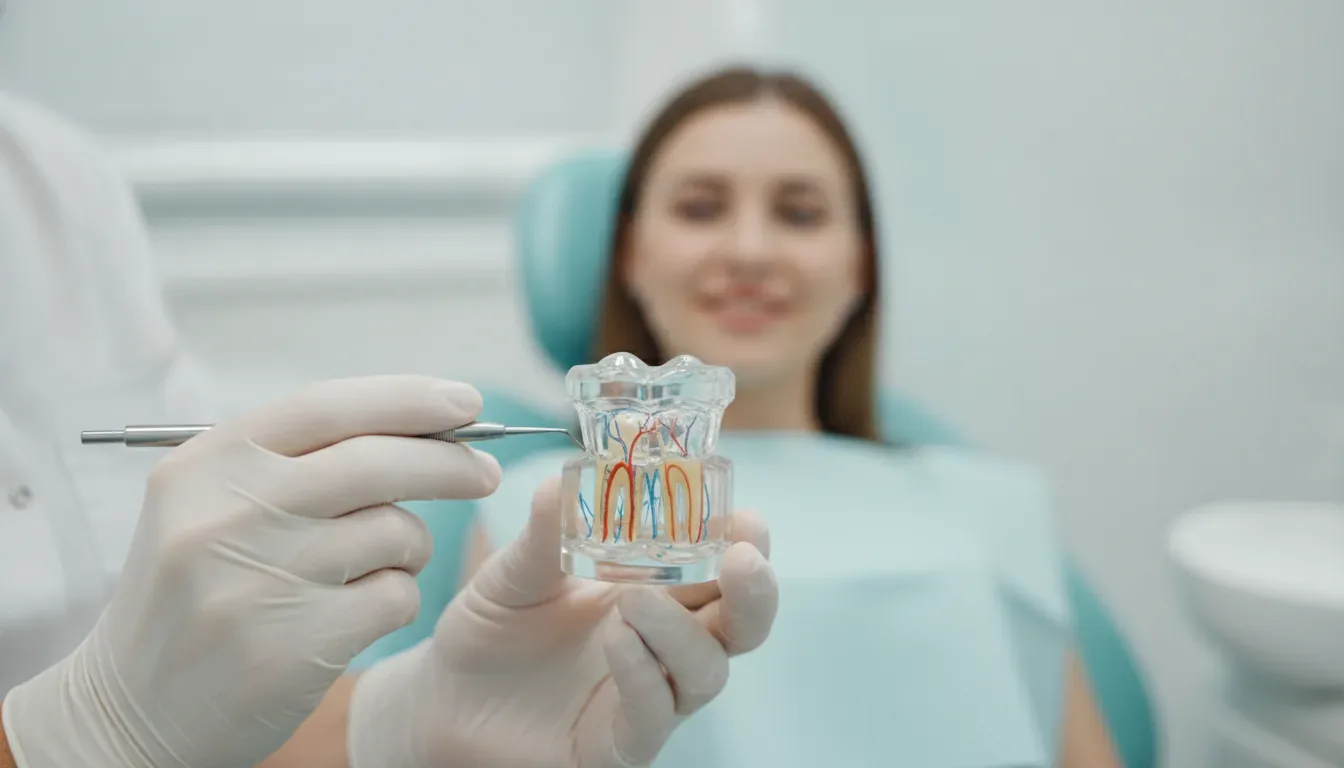
A dental filling is one of the most common things a dentist will ever recommend, and one of the least explained. You can walk out of an appointment holding a printed plan you cannot read, with words like caries and occlusal on it, and no clear idea of what you just agreed to. That is the fault of the vocabulary, not of you.
Most people nod along in the chair. The chair is not a good place to ask someone to slow down, the words come quickly, and the moment passes. Then you get home, look at the paperwork, and the questions start. Being confused by it is common. So is being nervous about the whole thing.
This guide translates it. What a filling is, how it differs from a cavity, what each word on your treatment plan means in plain English, what the appointment is like minute by minute, and what is normal in the days afterwards. No jargon left standing. Dentique Dental Care, which has offices in Downers Grove and Lemont, Illinois, provides judgment-free care for people who have avoided the dentist for years, so there is no judgment here either about the gap since your last visit.
What is a dental filling, in plain English?
A dental filling is a repair, not a treatment for pain: the dentist cleans the decay out of a small hole in the tooth and fills the space with a solid material, so the tooth works normally again and the hole cannot get bigger.
The short version:
- The National Institute of Dental and Craniofacial Research, part of the National Institutes of Health, describes a filling as the treatment used for a small hole, or cavity, in a tooth. The decayed tooth tissue is removed and the space is filled.
- Cleveland Clinic classes a dental filling as a type of restorative dentistry treatment, used to repair cavities or to fix minor chips and cracks.
- A filling appointment usually takes 30 to 60 minutes from start to finish, and most of those minutes are not drilling.
- Getting a filling should not hurt, because the dentist numbs the area with a local anesthetic first.
- A composite filling is the tooth-colored kind and an amalgam filling is the silver-colored kind. Those two materials cover most routine fillings. Tooth decay damages enamel, the hard outer surface of the tooth, and the filling replaces what has been lost.
- A cavity and a filling are two different things, and that difference is where the rest of this page starts.
On this page
Is a filling the same thing as a cavity
A cavity is the hole itself, the damage tooth decay has already done, and the dental filling is the repair that goes into it. They are not the same: the cavity is the problem, the filling is the fix.
The National Institute of Dental and Craniofacial Research puts the difference in a single line, describing a filling as the treatment used for a small hole, or cavity, in a tooth. The order is what matters. The decay comes first and makes the hole. The filling comes second and goes into the cleaned-out space.
Tooth decay works from the outside in. It breaks down enamel, the hard outer surface of the tooth, until a hole forms, and once it is through that layer it reaches dentin, the softer layer underneath.
Everyday speech blurs the two words. People say they have a filling when they mean there is already a repair in the tooth, and that they need a filling when a cavity has just been found. Same word, two different situations.
The plan you were handed uses several more words like these, and most of them never get said out loud.
What do the words on your treatment plan actually mean
A treatment plan is written in the language dentists use with each other, not the language they use with patients. The jargon is not deliberate, but it is real. Here is what each word on it means, in plain English, roughly in the order you are likely to meet it.
Caries. The clinical word for tooth decay. Dental caries and tooth decay are the same thing, so a plan listing caries on a tooth is telling you there is decay there.
Restoration. The general word for anything that rebuilds a tooth. Cleveland Clinic uses it to cover fillings, inlays, onlays, bridges and crowns, which makes a dental filling one kind of restoration among several.
Surface. Each tooth has several outer faces, and the plan counts how many of them the repair has to cover. That is why you see a one-surface filling, a two-surface filling, or three surfaces written next to the same tooth. More surfaces means a bigger repair, nothing more.
Occlusal surface. The chewing face on the top of a back tooth, the one that meets the tooth above it.
MOD filling. A filling that covers three faces of the same tooth: the front-facing side, the chewing surface and the back-facing side. The letters are only the names of those faces.
Local anesthetic. The numbing injection that switches off feeling in one small area while you stay fully awake. It is why the drilling does not hurt, and it is not the same as sedation.
Dental curing light. The small blue light held against a tooth-colored filling to set it hard. Composite goes in as thin layers, and each layer is hardened before the next one goes on.
Pulp. The soft living centre of the tooth, where the nerve is. Cleveland Clinic notes that once decay reaches the pulp a filling can no longer fix the tooth and a root canal is needed instead, which is why the depth of a cavity changes the recommendation.
Bite, or occlusion. How your upper and lower teeth meet. The dentist checks the bite at the end so the new filling is not standing proud of the tooth and catching when you close.
Direct filling and indirect filling. A direct filling is made in your mouth and finished in one visit. An indirect filling is made by a dental technician in a laboratory first and fitted at a second visit.
We will watch it. Chairside shorthand, and not a brush-off. It usually means the decay is early, has not yet made a hole worth filling, and will be re-checked at your next visit rather than drilled today. That is what dentists commonly mean by the phrase rather than the policy of any one practice.
If a word on your plan is not on this list, ask what it means before you sign it. Nobody minds the question, and the answer takes ten seconds.
Once the words make sense, the next question tends to arrive on its own. If the hole is small, why fill it at all?
Why does a small cavity need a filling at all
A tooth cannot grow back the part that decay has destroyed, the way skin closes over a cut or bone knits after a break. That is why a small cavity gets worse rather than better on its own, and why a dental filling is a repair rather than a cure.
So the honest answer to whether fillings are really necessary is that the hole does not close by itself. Once tooth decay has broken through enamel and made a hole, something has to fill the space, or the decay carries on into the tooth underneath. Holes in teeth get worse, which is why you need a filling once one has formed.
There is a stage before that one. Decay caught early, before it has broken through the enamel, can sometimes be monitored rather than filled, which is exactly what a dentist means by watching it. That is how two people can both be told they have decay and only one of them leaves with a filling booked.
What a filling does is restore the tooth to its normal function and shape while stopping the hole getting bigger, which is how Colgate describes it. What it cannot do is undo damage that has gone deeper. Cleveland Clinic is direct about the far end of that: if a cavity grows so large that it reaches the pulp, a filling will not fix the issue and a root canal is needed instead.
That is a general pattern in how decay behaves, not a prediction about your tooth. Which raises the part most people are picturing anyway when they hear the word filling: the appointment itself.
What actually happens when you get a filling
A single filling, start to finish and counting the numbing and the waiting, usually takes 30 to 60 minutes, and most of those minutes are not drilling. Aspen Dental, Whites Dental, Eagle Falls and Associates of Dentistry all publish a figure inside that range, and Dentique Dental Care’s own fillings page puts the process at under an hour.
How long does a filling take, minute by minute, according to that published guidance:
- Numbing the area. About 5 to 15 minutes for the local anesthetic to take full effect. You are waiting, and nothing is happening to the tooth yet.
- Removing the tooth decay. About 5 to 20 minutes. This is the drilling part, and it is shorter than most people expect.
- Placing the filling. About 10 to 20 minutes.
- Polishing and the bite check. About 5 to 10 minutes.
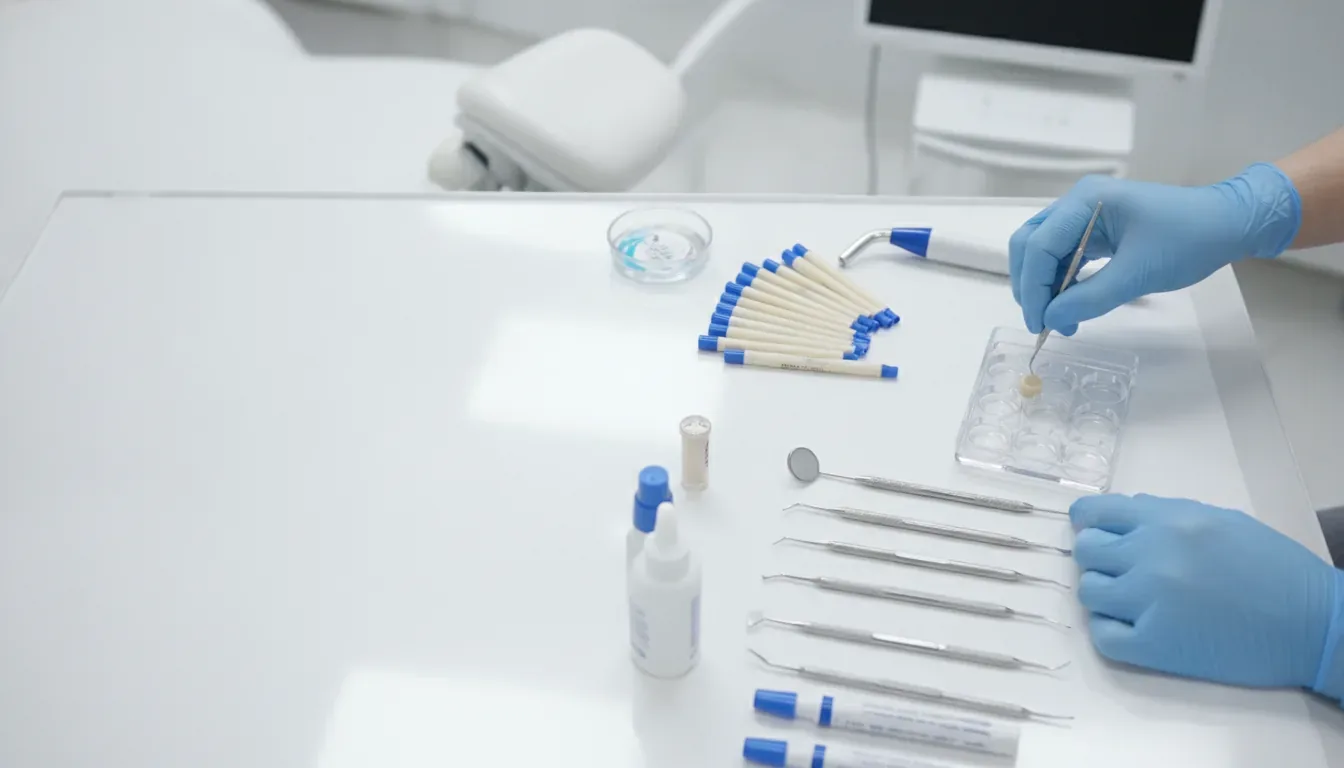
The step by step sequence inside that is the one Cleveland Clinic publishes: numb the tooth, remove the damaged or decayed tissue, fill the hole with the filling material, harden a tooth-colored material with a dental curing light, polish the rough edges, then check the bite so the repaired tooth meets the one above it the way the old surface did. That is what happens in the room, in order.
Two things move the number. Size, first: a small surface-level cavity runs about 20 to 30 minutes, while a deep or multi-surface cavity runs about 45 to 60 minutes. Material, second: a composite filling is placed and hardened in layers under the curing light, so it takes a little longer than an amalgam filling, which is packed in and sets on its own.
Almost nobody reads a timing breakdown for the timing. They read it because of the question sitting underneath it.
Does getting a filling hurt
Getting a filling is done under local anesthetic, and it should not hurt, because the area is numb before any drilling starts. Cleveland Clinic states it the same way: a filling should not hurt, because the dentist uses local anesthesia to numb the area.
What you can still feel is pressure, and some vibration. Neither is pain, but nobody tells you that in advance, so pressure can register as something going wrong. It is not.
If you do feel something sharp, say so. Cleveland Clinic’s guidance is that a patient who feels discomfort during the procedure should tell the dentist, who can then give more numbing medication. You are not interrupting and you are not being difficult. Stopping for thirty seconds is easier for everyone than sitting through it.
Does it hurt is the first thing most people want to know, and painful is usually the word they use, which says something about what gets carried into the room. For some people the sting of the injection is the whole fear. For others the fear is older than any one procedure, and no amount of reassurance about numbing touches it.
That second thing has a name, dental anxiety, and it is common enough to be planned for rather than lectured about. Dentique Dental Care offers nitrous oxide, which most people know as laughing gas, and oral conscious sedation for anxious patients. Sedation is treated as a routine option rather than an upsell, and there is no judgment attached to asking for it. Dr. Xhelo Shuaipaj DDS FDOCS FICOI holds a Fellowship with DOCS Education, which is a sedation fellowship, so it is a conversation he has often.
The next thing people usually want is the vocabulary for the filling itself, and what the different kinds are called.
What are the different kinds of fillings called
Fillings are named after the material they are made from, and after whether they are made in your mouth or in a laboratory. That is all the types of fillings really are: five materials and two ways of making them. The names are all you need to follow the conversation, so what follows is a glossary and not a shortlist.
The materials, as the American Dental Association and Cleveland Clinic describe them:
- Composite filling. The tooth-colored one, also called resin composite. The American Dental Association describes composite resins as a mixture of glass or quartz filler, used on either front or back teeth. These are what most people mean by white fillings.
- Amalgam filling. The silver one. The American Dental Association describes dental amalgam as a combination of metals that includes mercury, silver, tin and copper, and as very durable.
- Glass ionomer. A tooth-colored material made from a silica glass powder, described by Cleveland Clinic and used mostly for small cavities and for children.
- Gold filling. An alloy of gold, copper and other metals, which the American Dental Association notes has been used in dentistry for more than 1,000 years for its durability. It is made in a laboratory.
- Porcelain filling. A tooth-colored ceramic, which Cleveland Clinic describes as made from feldspar, quartz and kaolin. Also made in a laboratory.
The two ways of making them:
- Direct filling. Made and placed in your mouth in a single visit.
- Indirect filling. Made by a dental technician in a laboratory first, then fitted, which usually means two visits.
- Inlay and onlay. Two kinds of indirect filling, used when a tooth has too much damage to hold a filling but not enough to need a crown. Cleveland Clinic describes them as fitting into the existing tooth like a puzzle piece.
Composite and amalgam are the two materials used for most routine fillings at Dentique Dental Care. The other three materials, and inlays and onlays, appear above as vocabulary, so the words are not strange when you hear them.
Which of the two routine materials suits a particular tooth is a separate conversation, and it belongs with the dentist who is looking at that tooth. What happens once the filling is in is the same either way, and that is what most people want next.

What is normal after a filling, and what is not
Mild sensitivity and a little soreness are the usual experience in the days after a filling, and they are temporary. Cleveland Clinic describes minor tooth sensitivity and gum soreness in the area as normal, and expects them to go away in a week or two. Dentique Dental Care’s own page says something similar about a tooth that feels sensitive to hot, cold or biting: mild, a few days, then fading.
How long that lasts is the question people ask that same evening, so here are the parts of it separately.
Eating. You can technically eat straight away, because as Cleveland Clinic notes, eating will not damage the new dental filling. The reason to wait is the numbness. While the local anesthetic is still working you can bite your cheek or your tongue without feeling it, so waiting until the numbness has fully worn off avoids the one injury a filling appointment tends to cause.
Normal activity. Unless you had sedation, Cleveland Clinic says you should be able to return to routine activities immediately after the appointment.
Soreness. Cleveland Clinic’s guidance points to over-the-counter pain relievers such as acetaminophen or ibuprofen. That is general guidance from a published source rather than advice for your situation, and anything that is not settling is worth a call to your own dentist.
What is not normal, and what does mean picking up the phone:
- The filling breaks or comes out.
- Severe pain that does not go away with medication.
Cleveland Clinic lists both as reasons to call your dentist right away. Call the office, describe what you are feeling, and let them work out how soon you need to be seen.
That covers the first week or two. The longer run is a different question.
How long do fillings last, and can a tooth decay under one
A dental filling is a repair with a working life, not a permanent part of the tooth. The National Institute of Dental and Craniofacial Research, which you will see written as NIDCR, states that dental fillings and crowns do not last a lifetime and may need to be replaced. A filling being replaced is normal, rather than a sign that anything went wrong.
How long do fillings last in practice? Cleveland Clinic says that depending on the material, some fillings can last up to 20 years. Dentique Dental Care’s own page publishes narrower spans: about 5 to 10 years for a composite filling, and about 10 to 15 years or more for an amalgam filling.
Can a tooth rot under a filling? Decay under a filling is possible. New decay can start at the edge of an existing one, and looking for it is one of the things a dentist does at a routine dental check-up. A filling does not seal a tooth against tooth decay for life. It repairs the damage that decay has already done.
A filling that fell out, or one that has broken, is a call rather than a panic. Cleveland Clinic lists a broken filling among the reasons to call your dentist right away, because the tooth underneath is uncovered until it is repaired.
A filling reaching the end of its working life is one thing. A cavity that has gone past what any filling can fix is another.
When is a filling not the right fix
A filling is the smallest repair available once a cavity has formed. It stops being the right fix in two situations: when there is too little healthy tooth left to hold it, and when tooth decay has reached the pulp.
For the first, there is a step in between. Cleveland Clinic describes inlays and onlays as what dentists use when a tooth has too much damage to support a filling but not enough damage to warrant a dental crown. So the sequence is not filling and then crown. It is filling, then inlay or onlay, then crown, with each step covering more of the tooth than the one before it and each one a bigger repair.
For the second, Cleveland Clinic is direct: if a cavity grows so large that it reaches the pulp, a dental filling will not fix the issue, and a root canal is needed instead. People ask when it is too late to fill a tooth, and that is the line.
Is a root canal worse than a filling? Both are done under local anesthetic, and the difference is what is being treated rather than what you feel. A filling repairs the hole in the outer surface of the tooth. A root canal treats the infected soft centre.
Dentique Dental Care covers that whole path: fillings as part of general and family dentistry, plus crowns and bridges, root canal therapy and extractions. A tooth that turns out to need more than a filling is still handled in the same place.
Who you would sit down with for any of it, in Downers Grove or Lemont, is one person.
What is it like getting a filling in Downers Grove or Lemont
Dentique Dental Care has two offices, one in Downers Grove and one in Lemont, and one dentist who works across both. The same person explains the plan, places the filling, and sees you at the check-up afterwards.
The offices are at 4121 Fairview Ave, Suite 205, Downers Grove, IL 60515, and 15543 W 127th St, Suite 103, Lemont, IL 60439, both in Illinois. Dr. Xhelo Shuaipaj DDS FDOCS FICOI is the practice’s sole dentist, with more than 30 years in practice, rotating between the two.
What that looks like for someone who has stayed away a while: nobody counts the years out loud. The practice provides judgment-free care for people who have avoided the dentist, and treatment planning without pressure to say yes in the chair. There is no judgment about the gap, whatever its length. If you want the words on your plan explained in plain English before you agree to anything, ask, and they get explained.
For anxious patients there are two comfort options, nitrous oxide and oral conscious sedation. Asking for either is treated as an ordinary request.
On money, the practice’s approach is that your price is confirmed in writing at the consultation rather than guessed at over the phone. Across the two offices, patients have left over 400 five-star Google reviews, at a 4.9 rating.
Whatever is still open after all of that, the questions below are the ones that come up most.
Common questions about fillings
Is a filling the same as a cavity?
A cavity is the hole that tooth decay made, and a dental filling is the repair that goes into it. The two words describe the damage and the fix, not the same thing.
How long does a filling take?
A single filling usually takes 30 to 60 minutes from start to finish, including the 5 to 15 minutes the local anesthetic needs to take full effect. A small surface-level cavity runs shorter, at about 20 to 30 minutes.
How many fillings can a dentist do in one visit?
More than one filling is often placed in a single appointment when the cavities are close together, for instance on neighbouring molars, which means fewer visits and fewer numbing injections. Treating two or three at once does add chair time to the appointment.
Do fillings remove decay?
A filling removes the decay first. The decayed tissue is taken out and the filling goes into the cleaned space, so the decay is not covered over and left underneath.
Can I eat after a filling?
Eating after a filling is best left until the numbness has fully worn off, mostly so you do not bite your cheek or your tongue without feeling it. The filling itself is not at risk.
Can I brush my teeth after a filling?
Brushing and flossing after a filling can carry on as normal, unless your dentist tells you otherwise.
Why is a white filling set with a blue light?
A tooth-colored filling is placed in thin layers, and each layer is hardened with a dental curing light before the next one goes on. That is why a composite filling takes a little longer to place than an amalgam filling, which sets on its own.
How much does a filling cost?
This page does not carry prices. At Dentique Dental Care your price is confirmed in writing at the consultation.