Dental Implants vs Dentures comes down to one stark difference: implants can last a lifetime, while dentures need replacing every 5 to 7 years. That single fact reshapes the entire comparison — and if you’re weighing these two options right now, this page gives you the full picture: how each works, what each may cost at Dentique, and which one fits your specific situation.
A 2026 large-scale study of 158,824 implants published in the Journal of Functional Biomaterials recorded a clinical success rate of 97.83%, with 20-year survival rates above 90%, making dental implants the longest-lasting tooth replacement option available. Dentures, by contrast, typically require replacement every 5 to 7 years as the jawbone changes shape beneath them.
Source: Journal of Functional Biomaterials, 2026; American Academy of Implant Dentistry.
Yes, the price tag on implants can cause sticker shock at first glance. But the long-term math tells a different story. Below is the honest, side-by-side comparison, with estimated pricing for both options at Dentique. Final pricing is always determined at your consultation, since every case is different.
Dental Implants vs Dentures: Side-by-Side Comparison
| Factor | Dental Implants | Dentures |
| Lifespan | 20+ years; can last a lifetime with proper care | 5 to 7 years before replacement needed |
| Bone Preservation | Yes. Titanium post stimulates jawbone and prevents bone loss | No. Bone continues to resorb; jaw shape changes over time |
| Upfront Cost (Dentique)* | Starts from an estimated $5,000+ all-inclusive per tooth | Starts from an estimated $2,500+ per arch |
| Long-Term Value (20 yrs) | Typically a one-time investment | Cumulative cost grows with multiple replacements |
| Stability | Fixed. Functions like a natural tooth; no movement | May shift or slip, especially over time as bone changes |
| Maintenance | Brush and floss normally. No removal required | Remove nightly; require adhesives; periodic relines needed |
| Surgery Required | Yes. Minor surgical procedure; healing time 3 to 6 months total | No surgery. Faster to complete |
| Sedation Available at Dentique | Yes. Nitrous oxide or oral sedation available for anxious patients | Not applicable |
| Ideal Candidate | Good bone density, healthy, willing to undergo minor surgery | Limited budget, significant bone loss, or cannot have surgery |
Estimated price range only. Actual cost is determined after consultation and varies based on case complexity, bone health, materials selected, and whether additional procedures such as bone grafting are needed. Contact Dentique for a personalized quote.
For a deeper look at the implant process and what to expect, visit our page on dental implants at Dentique.
Dental Implants: Permanent Tooth Replacement That Lasts a Lifetime
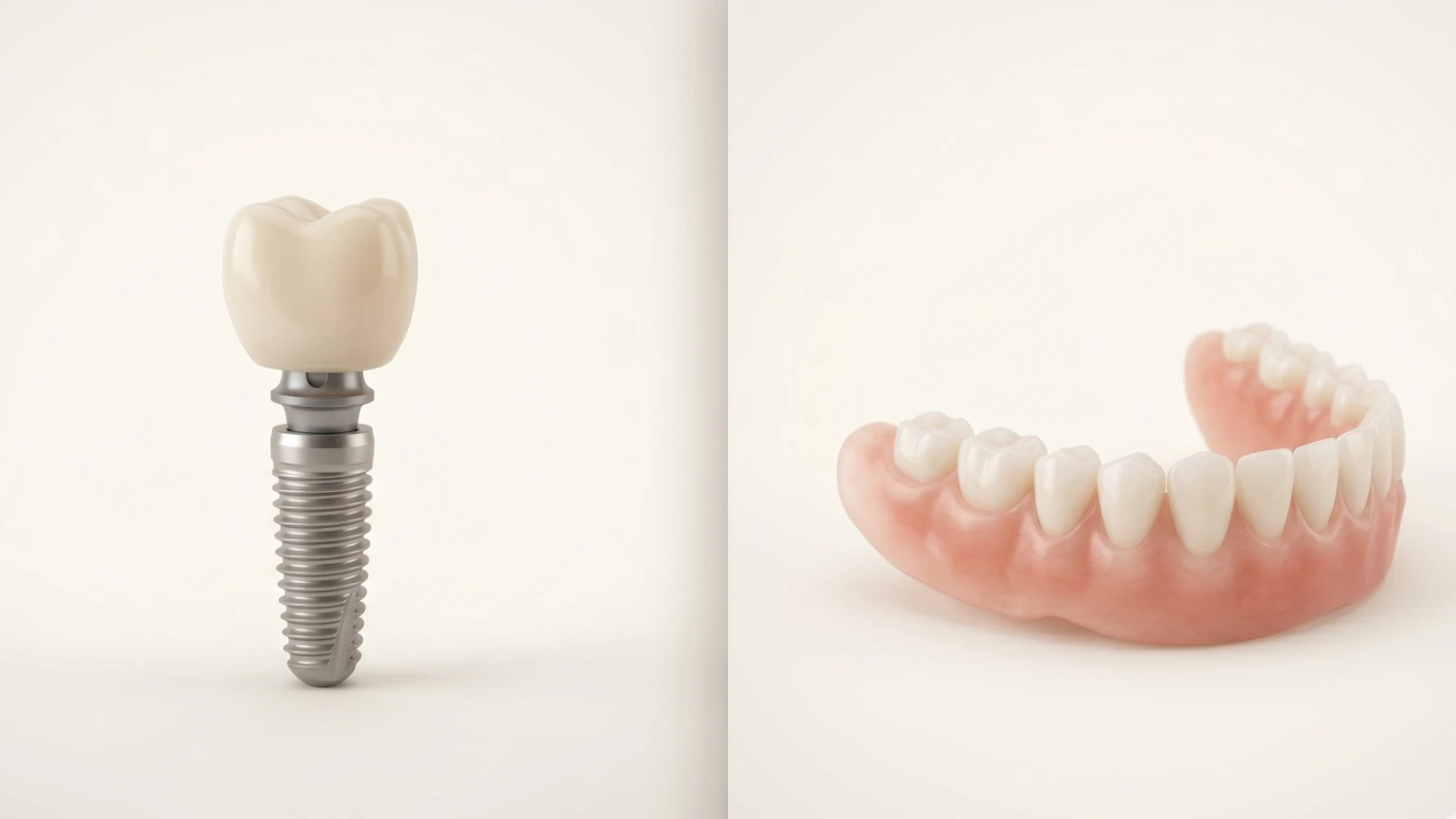
A dental implant replaces the entire tooth, root and all. A titanium post is surgically placed into the jawbone, where it fuses with the bone through a process called osseointegration. Once integrated, a custom crown is attached on top. The result is a replacement tooth that looks, feels, and functions like the natural one that was lost.
Dr. Xhelo Shuaipaj, DDS, holds implant placement certification and has helped patients across Downers Grove and Lemont reclaim full chewing function and a natural-looking smile. In practice, patients who choose implants most often describe the outcome as worth every penny once they experience the difference.
Pros of Dental Implants
- Permanent tooth replacement; no removal required
- Looks and functions like a natural tooth
- Prevents jawbone loss by stimulating the bone the way a natural root does
- 97.83% clinical success rate across large-scale 2026 research
- No adhesives, no nightly removal, no relines
- Can last a lifetime with proper care; 20-year survival rates above 90% per the American Academy of Implant Dentistry
Cons of Dental Implants
- Requires minor surgical procedure and local anesthesia
- Healing and osseointegration take 3 to 6 months total
- Higher upfront cost than dentures
- Not suitable for patients with active bone disease, uncontrolled diabetes, or insufficient bone density without grafting
Ideal Candidate for Dental Implants
Implants are best suited for patients with adequate bone density, good general health, and the ability to undergo a minor surgical procedure. If anxiety about the procedure is a concern, sedation dentistry is available for implant patients at Dentique. With nitrous oxide or oral sedation, many patients are fully relaxed or asleep through the process. Learn more about sedation for implant procedures.
For patients who were told they are not candidates due to bone loss, bone grafting may restore eligibility. Dr. Shuaipaj evaluates each case individually. For details on what the process involves, the Mayo Clinic guidelines on dental implant surgery offer a thorough clinical overview
Dentures: An Accessible, Removable Option for Tooth Replacement
Dentures are custom-fitted replacements for missing teeth, made from acrylic or porcelain teeth set in a gum-colored base. They are held in place by suction or dental adhesive and removed each night for cleaning. For patients who cannot undergo surgery or need a faster, lower-cost solution, dentures remain a legitimate and widely chosen option.
More than 36 million Americans are missing all natural teeth, and around 90% of them use some form of dentures, according to CareCredit research. Dentures are typically completed in a matter of weeks, compared to the multi-month timeline for implants.
Pros of Dentures
- No surgery required; faster to complete
- Lower upfront cost than implants
- Accessible for patients with significant bone loss who cannot have implants
- Can replace a full arch or multiple teeth at once
Cons of Dentures
- Must be removed nightly for cleaning
- Require adhesives and may shift or slip over time
- Do not prevent bone loss; as the jaw changes shape, fit deteriorates
- Replacement needed every 5 to 7 years as the jawbone resorbs
- Cannot fully restore chewing force compared to implants
Ideal Candidate for Dentures
Dentures are the right starting point for patients with a limited budget, significant existing bone loss, or a medical condition that rules out surgery. They are also a valid bridge solution for patients who plan to transition to implant-supported dentures later. The decision is not about which option is better in the abstract. It is about which one fits your bone health, your budget, and your lifestyle.
You can explore our options for dentures in Downers Grove to see how Dentique approaches this treatment for patients across the western suburbs.
Already wearing dentures? Implant-supported dentures may offer the stability you have been looking for. Four or more implants anchor your denture securely, eliminating adhesives and slippage. Ask Dr. Shuaipaj about this upgrade path at your consultation.
Which Is Right for You? How to Choose Between Implants and Dentures
Dentures
Every patient’s situation is different. Use these decision guides to orient your thinking before your consultation.
- If you want a permanent solution and can undergo a minor surgical procedure: dental implants are the better long-term investment, especially if preserving jawbone health matters to you.
- If upfront cost is the immediate constraint: dentures are a legitimate starting point and can be upgraded to implant-supported dentures later as your budget allows.
- If you have significant bone loss already: consult Dr. Shuaipaj directly. Some patients who were told they were not implant candidates have been able to proceed after bone grafting.
- If you are anxious about surgery: sedation dentistry is available for implant procedures at Dentique. Nitrous oxide or oral sedation keeps most patients comfortable throughout.
- If you are missing multiple teeth or a full arch: implant-supported dentures or All-on-4 implants may offer the best of both worlds. Ask about this option during your consultation.
Cost is a real factor in this decision. Payment plans are available for both implants and dentures at Dentique through CareCredit and Cherry Financing, so the long-term math is worth working through before ruling either option out.
Not sure which option fits your situation? Dr. Shuaipaj can review your bone health and provide personalized pricing in a single consultation. Schedule a Consultation
Dental Implants vs. Dentures: What Does Each Cost at Dentique?
Nationally, a single dental implant ranges from $3,158 to $6,533 per tooth (Aspen Dental 2026 data). At Dentique, all-inclusive implants start at an estimated $5,000+ per tooth, with the post, abutment, and crown included. The exact cost depends on case complexity, bone health, and any preparatory procedures (such as bone grafting) that may be needed — so the final number is set during your consultation, not online.
Dentures at Dentique start at an estimated $2,500+ per arch, with final pricing also confirmed at your consultation based on the type of denture, materials, and the fit your jaw requires.
| Dental Implants | Dentures | |
|---|---|---|
| Dentique (Estimated)* | Estimated from $5,000, up to $7,000 all-inclusive per tooth | Estimated from $2,500, up to $3,500 per arch |
| National Average | $3,158–$6,533 per tooth | $452–$6,514 per arch |
| Lifespan | 20+ years (can be permanent) | 5 to 7 years before replacement |
| Long-Term Cost (20 yrs) | Typically a one-time investment | Cumulative cost grows with multiple replacements |
| Insurance Coverage | Partial (often crown portion covered) | Often partial coverage |
| Financing | Available at Dentique | Available at Dentique |
Estimated price range only. Actual cost is determined after consultation and varies based on case complexity, bone health, materials selected, and whether additional procedures such as bone grafting are needed. Contact Dentique for a personalized quote.
Here is the long-term math most comparison articles skip. Dentures replaced 3 to 4 times over 20 years, plus adhesive costs and periodic relines, can add up considerably. A single implant, maintained with normal brushing and flossing, is typically a one-time investment that can last a lifetime. The sticker shock of implants fades when the long-term picture is laid out side by side.
Flexible payment plans are available through CareCredit and Cherry, making it possible to spread the cost of implants over time. We also accept dental insurance for implants, with partial coverage typically applying to the crown portion. Ask our team about your specific plan at your consultation.
Frequently Asked Questions: Dental Implants vs. Dentures
Are dental implants better than dentures?
Implants are the better long-term option for most patients who qualify. They last 20 or more years, prevent jawbone loss, and function like natural teeth. Dentures are the better option for patients who cannot undergo surgery, have significant bone loss, or need a lower upfront cost. The right choice depends on your bone health, your budget, and your lifestyle. Visit our page on dental implants at Dentique for a full overview of candidacy.
How long do dental implants last compared to dentures?
With proper care, dental implants can last 20 years or more. Many patients keep them for life. A large-scale 2026 study published in the Journal of Functional Biomaterials found a 97.83% clinical success rate across 158,824 implants. Dentures typically require replacement every 5 to 7 years as the jawbone changes shape. Over a 20-year period, the total cost of multiple denture replacements often matches or exceeds the one-time cost of an implant.
What is the cost difference between dental implants and dentures?
At Dentique, dental implants are typically estimated to start from $5,000 and range up to $7,000 all-inclusive (post, abutment, and crown), and dentures are typically estimated to start from $2,500 and range up to $3,500 per arch. These are estimated ranges only — final pricing is determined during your consultation based on case complexity, bone health, and your specific treatment needs. Nationally, implants range from $3,158 to $6,533 per tooth and dentures from $452 to $6,514 per arch. Implants cost more upfront, but the long-term cost of denture replacements often closes the gap. Financing is available for both options.
Who is not a good candidate for dental implants?
Patients with uncontrolled diabetes, active bone disease, heavy smoking habits, or inadequate bone density may not immediately qualify. However, bone grafting can restore candidacy for many patients who were initially told no. During a consultation, Dr. Shuaipaj evaluates bone health and overall health to determine whether implants are right for you. The Mayo Clinic guidelines on dental implant surgery provide a helpful clinical overview of contraindications.
Can you get dental implants if you already have dentures?
Yes. Implant-supported dentures (sometimes called snap-in dentures) are a popular option for current denture wearers who want more stability. Four or more implants anchor the denture securely, eliminating adhesives and slippage. This is a common upgrade path for patients who started with traditional dentures. Ask Dr. Shuaipaj about implant-supported denture options. You can also explore our dentures in Downers Grove page for details on what Dentique offers.