
Teeth grinding happens while you are asleep, which is why most people never notice it themselves. You hear about it from a partner, or you wake with a sore jaw and a dull headache, or a dentist points at worn edges on your teeth. Bruxism is the clinical name for teeth grinding. It is common, it is worth looking at, and finding out what is going on does not commit you to treatment.
At Dentique Dental Care in Downers Grove and Lemont, a first visit for jaw pain or clenching is a look, an explanation, and an honest answer about whether you need anything. Dr. Xhelo Shuaipaj DDS FDOCS FICOI fits custom night guards and checks the jaw joint for signs of a TMJ disorder. If you grind your teeth and the wear is minor, he will say so rather than sell you an appliance. Your price is confirmed in writing at the consultation, before anything is made.
This practice is built for people who have avoided the dentist for years, and nobody comments on how long it has been.

Bruxism is the medical name for teeth grinding and clenching, usually during sleep, and it wears teeth down and can leave your jaw sore in the morning.
A temporomandibular disorder (TMD) is a group of more than 30 conditions that cause pain and dysfunction in the jaw joint and the muscles that control jaw movement (NIDCR, reviewed August 2026).
A night guard, also called an occlusal guard, is an appliance worn over the teeth during sleep that protects them from the force of grinding, and it does not stop the grinding itself (ADA).
NIDCR puts TMD at about 5% of adults in the United States, and notes that the figure varies depending on how the condition is studied and assessed. That page was last reviewed in August 2026.
The signs the ADA lists for grinding are the ones most people arrive with: jaw pain or tenderness, dull headaches, neck pain, and chipped, cracked or worn spots along the edges of the teeth. Almost nobody arrives with a diagnosis. They arrive with one of those signs.
Pain or tenderness in your jaw. Dull headaches. Plugged, painful or itchy ears. Neck pain. (ADA MouthHealthy)
Chipped or cracked teeth. Worn, damaged spots along the edges of the teeth. These show up at an exam long before most people feel anything. (ADA MouthHealthy)
A jaw that locks or will not open fully. Pain that has changed how you eat or sleep. Say so when you book rather than waiting for your next checkup, and the office will come back to you.
The ADA lists the signs a person notices as pain or tenderness in the jaw, dull headaches, plugged, painful or itchy ears, and neck pain. The signs a dentist sees are different: chipped or cracked teeth, or worn, damaged spots along the edges of the teeth. That distance between what you feel and what shows up on the teeth is why grinding runs for years without being caught.
A TMJ disorder presents differently again. NIDCR lists pain in the chewing muscles or the jaw joint, pain spreading to the face or neck, jaw stiffness, limited jaw movement or locking, painful clicking, popping or grating, ringing in the ears or dizziness, and changes in how the bite feels. NIDCR also records that TMDs are twice as common in women as in men, and most common in women between 35 and 44 years old.
If your jaw locks, will not open fully, or the pain has started changing how you eat or sleep, say that when you book rather than waiting for your next checkup. Dr. Xhelo Shuaipaj DDS FDOCS FICOI checks the jaw joint and looks for those wear patterns during an exam.
Sleep bruxism rarely has one single cause, and stress, sleep, some medications and everyday habits all play a part, which is why treatment starts by protecting the teeth rather than by changing them. NIDCR states plainly that research does not support the belief that a bad bite or orthodontic treatment causes TMDs.
That second sentence carries more weight than it looks, because it is where a good deal of advice on this topic goes wrong. NIDCR describes the contributing factors for TMD as a combination of genes, psychological and life stressors, and how someone perceives pain. If you have been told a bad bite is the root cause of your jaw pain and that permanent bite work is the answer, that is worth a second opinion before you agree to it.
For grinding at night, the ADA points at habits as well: people who smoke or drink alcohol or coffee are twice as likely to grind their teeth. The ADA also names sleep disorders, misaligned teeth, and missing or crooked teeth among the causes.
Grinding is not the only reason a dentist suggests a guard. Cleveland Clinic lists contact sports, snoring or sleep apnea, and TMJ disorder as the other situations where one gets recommended, which is why a dentist asks about your sleep as well as your teeth.
Because the causes sit in a mix like that, the first step is the reversible one: protect the teeth, see what changes, and leave the permanent options alone until there is a reason to consider them.
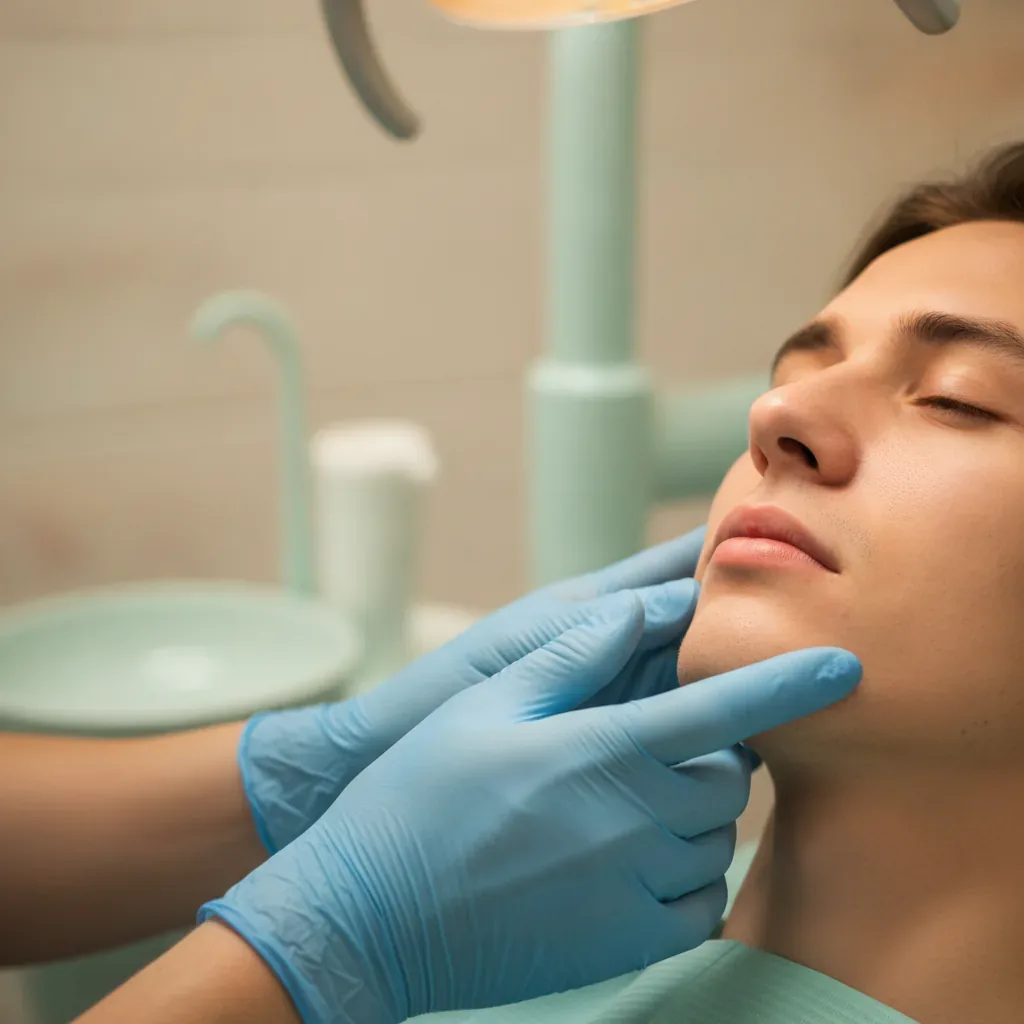
A first visit for grinding or jaw pain is an exam, a look at how your teeth have worn, and questions about your sleep and your jaw, and you leave knowing whether you need anything at all. The ADA describes it as a careful exam, possibly including dental x-rays, to look for the possible cause.
Dentique Dental Care evaluates jaw pain and fits custom-made night guards, also called occlusal guards, at both offices. What follows the exam depends on what the exam finds, and it does not always end in an appliance.
NIDCR is direct about the order things should happen in. Experts recommend conservative treatments and avoiding treatments that permanently change the jaw joints, teeth, or bite, or involve surgery. NIDCR also advises that before agreeing to anything irreversible you discuss the potential benefits, risks, and alternatives with your doctor or dentist. A night guard sits at the conservative end of that ladder, which is why it comes first.
Custom-made to your own teeth rather than shaped at home.
Fitted, checked, and adjusted if it does not sit right.
A night guard comes in three forms: off-the-shelf from a pharmacy, mail-order custom from an online lab, and custom-made by your dentist. They differ in fit, in how long they last, and in whether anyone checks your jaw before you start wearing one.
Cleveland Clinic sorts the store-bought kind into two. Stock mouth guards are worn as-is, right out of the box. Boil-and-bite mouth guards can be slightly customized at home. Its assessment of both is that they cost less than custom-made mouth guards but do not protect as well, and that custom-made mouth guards tend to be more comfortable and last longer. A custom-fit guard is built to the shape of your own teeth, which is where the comfort and lifespan difference comes from.
The difference that has nothing to do with the plastic is the exam. When a guard comes from a dentist, somebody has looked at your teeth and your jaw first and gone looking for the cause, which the ADA describes as the point of the visit. An over the counter guard protects teeth from a problem nobody has examined.
That does not make the pharmacy option worthless, and pretending otherwise would be dishonest. If your grinding is occasional, the wear is minor, and you want something tonight while you wait for an appointment, a boil-and-bite guard is a reasonable place to start. It is a poor place to stay if you are grinding hard enough to crack a tooth.
| From a pharmacy | Mail-order online lab | Made by your dentist | |
|---|---|---|---|
| Fit | Worn as-is, or shaped at home by boiling and biting | Made from an impression you take yourself at home | Custom-fit from an impression or scan taken in the office |
| Comfort and lifespan | Cleveland Clinic: cheaper, but does not protect as well as custom-made | Custom-made, but the fit depends on the impression you took | Cleveland Clinic: tends to be more comfortable and to last longer |
| Is your jaw examined first | No | No | Yes, and the cause is looked for |
| Adjusted if it does not fit | No, you buy another | Return or remake by post | Checked and adjusted in the office |
| Typical national cost | $20 to $30 | $50 to $200 | $300 to $1,000 |
| When this one is a reasonable choice | Occasional grinding, minor wear, or a stopgap while you wait for an appointment | You have already been examined and you want a spare or a replacement | There is visible wear, cracking, or jaw pain, or nobody has looked yet |
A custom night guard from a dentist is quoted nationally at anywhere from $300 to $1,000 depending on your insurance, according to GoodRx. What you pay depends on your plan, and Dentique Dental Care confirms your price in writing before anything is made.
Those figures come from GoodRx, “How Much Does a Dental Night Guard Cost?”, published June 23, 2022. They are national figures. They are not Dentique’s fees.
GoodRx reports that night guards are typically covered by dental insurance as long as your dentist determines they are medically necessary, commonly at 50% of the allowable amount, and that plans often set a frequency limit. The example GoodRx gives is UnitedHealthcare Dental coverage guidance suggesting one night guard every 36 months.
Two other numbers decide what you pay out of pocket. Your deductible is the amount you cover yourself before the plan pays anything at all. Your annual maximum is the ceiling on what the plan will pay across a whole year, so a guard that gets approved uses part of that ceiling and leaves less for anything else you need in the same year.
Dentique Dental Care works with most major PPO plans, including Delta Dental, MetLife, Cigna, Aetna, Blue Cross Blue Shield of Illinois, UnitedHealthcare, Guardian and Humana.
Your price goes to you in writing at the consultation, before anything is made.
Night guards get recommended a lot, and the suspicion behind that is fair. A real recommendation points at something the dentist can show you, wear on specific teeth, a crack, a recession line, and you should ask to see it.
People search for why dentists are pushing night guards, and it deserves a straight answer rather than a defence. The test is physical evidence. If you really need a guard, there is something on your teeth that can be pointed at with a mirror or shown to you on a photograph. The ADA sets out what a dentist is looking for: chipped or cracked teeth, or worn, damaged spots along the edges of the teeth. If someone recommends a guard and cannot show you any of that, you are entitled to ask what is being treated.
The second thing worth knowing is what a guard does not do. It protects the teeth from the force of grinding. It does not stop the grinding, and it does not treat whatever is behind it. Anyone who tells you a guard will fix your bruxism is overselling an appliance.
At Dentique Dental Care the treatment planning is no-pressure, and that comes from patients rather than from the practice describing itself. Patients volunteer, unprompted, that they were not upsold.
Dr. Xhelo Shuaipaj DDS FDOCS FICOI will tell you if the wear on your teeth does not justify a guard yet.
Inhaled through a small mask. Takes effect quickly and wears off quickly. You stay awake and aware throughout.
A form of sedation dentistry that helps you feel deeply relaxed during treatment while remaining responsive and able to communicate.
If you are anxious about dental visits, the practical question is what sedation feels like. Oral conscious sedation is described on the practice’s own sedation page as leaving you deeply relaxed during treatment while remaining responsive and able to communicate. Nitrous oxide is inhaled, it takes effect quickly and wears off quickly, and you stay awake throughout.
Dr. Xhelo Shuaipaj DDS FDOCS FICOI holds FDOCS, a fellowship from DOCS Education, which is a sedation credential rather than a general dental one. There is no judgment attached to any of this, and no remark about how long it has been since your last appointment.
A general dentist can assess grinding, protect worn teeth, and screen your jaw joint, but jaw locking, pain that is not improving, or a suspected sleep disorder belong with someone who treats those specifically. Knowing which side of that line you are on is worth more than any appliance.
An orofacial pain specialist treats jaw and facial pain as its own field. An oral and maxillofacial surgeon handles the joint itself when surgery is on the table. If snoring or sleep apnea is part of the picture, that is a medical assessment before it is a dental one, and Cleveland Clinic lists snoring or sleep apnea, along with TMJ disorder, among the reasons a guard gets recommended in the first place.
NIDCR’s guidance is worth reading before you agree to anything permanent. Experts recommend conservative treatments and avoiding treatments that permanently change the jaw joints, teeth, or bite, or involve surgery, and you should discuss the potential benefits, risks, and alternatives with your doctor or dentist first.
Dr. Xhelo Shuaipaj DDS FDOCS FICOI will refer you on when the picture calls for it rather than treating around the edges of it. None of that is a reason to skip the first appointment. It is a reason to expect a straight answer at it.
Dentique Dental Care is one dentist, Dr. Xhelo Shuaipaj, more than 30 years in practice, rotating between Downers Grove and Lemont, and patients stay with him for 15, 20 and 25 years and say so themselves.
In full, he is Dr. Xhelo Shuaipaj DDS FDOCS FICOI: DDS, plus FDOCS, Fellow of DOCS Education, which is the sedation fellowship, and FICOI, Fellow of the International Congress of Oral Implantologists. The practice carries hundreds of Google reviews across both offices.
Night guards protect the teeth from the force of grinding, which the ADA describes as their job. A night guard, also called an occlusal guard, does not stop bruxism itself and does not treat what is causing it. If your teeth are wearing down, the guard is what stands between the grinding and the damage.
A guard from a dentist is worth it when there is real wear, because Cleveland Clinic reports that custom-made mouth guards tend to be more comfortable and last longer than store-bought ones, and because somebody examines your jaw before you wear it. If your grinding is occasional and the wear is minor, a boil-and-bite guard is a reasonable starting point.
A night guard from a dentist is quoted nationally at $300 to $1,000 depending on insurance, according to GoodRx, published June 23, 2022. That is a national figure and not a Dentique fee. Your own price is confirmed in writing at the consultation.
A dentist makes a custom mouth guard from an impression or a digital scan of your teeth, and Dentique Dental Care fits custom night guards at both offices. The guard is checked for fit and adjusted rather than sold as-is.
A general dentist can screen the jaw joint, assess grinding and protect worn teeth, which covers most people who arrive with a sore jaw. Jaw locking, pain that is not improving, and suspected sleep disorders sit with an orofacial pain specialist, an oral and maxillofacial surgeon, or a physician instead.
A night guard takes getting used to, and the usual complaints are soreness in the first few nights, the extra cleaning, and replacing it as it wears through. If a guard leaves your teeth feeling odd or sore beyond the first week, go back and have the fit checked rather than stopping or adjusting it yourself.
Dental plans decide orthodontic coverage on their own medical-necessity rules, and jaw pain on its own does not settle it. Invisalign is an orthodontic treatment for aligning teeth and is not a treatment for a TMJ disorder. Ask your carrier what your specific plan covers before you assume either way.
Dr. Xhelo Shuaipaj DDS FDOCS FICOI is the dentist at Dentique Dental Care in Downers Grove and Lemont, in practice more than 30 years, and he reviewed this page for clinical accuracy.
His credentials are DDS; FDOCS, a fellowship from DOCS Education covering sedation; and FICOI, a fellowship of the International Congress of Oral Implantologists.
Reviewed for clinical accuracy by Dr. Xhelo Shuaipaj DDS FDOCS FICOI.
One appointment is an exam and an honest read on whether you need anything, and if you do, your price in writing before anything is made. There is no pressure attached to either answer.
Book a no-pressure consult with Dr. Xhelo Shuaipaj DDS FDOCS FICOI at either Dentique Dental Care office.
Get the smile you deserve today!